Foundation Inference Models (FIMs) are pretrained deep neural network models that perform zero-shot (or in-context) inference of dynamical systems from noisy time series data, and can easily be fine-tuned to specific tasks.
Our released FIMs include:
FIMs for Markov Jump Processes (Berghaus et al. (2024), huggingface)
FIMs for Point Processes (Berghaus et al. (2026), huggingface)
FIMs for Stochastic Differential Equations (Seifner et al. (2025), huggingface)
FIMs for Ordinary Differential Equations (Hübers et al. (2026), huggingface)
FIMs for Zero-shot Time Series Imputation (Seifner et al. (2025), huggingface)
Currently, we are working on releasing
FIMs for Accelerating Coarse-graining and Equation Discovery (Hinz et al. (2025))
Defining FIMs
A satisfactory FIM should be able to cope with dynamic phenomena of very diverse nature and thus
capture various secular and seasonal patterns, as well as non-periodic fluctuations;
handle observations from empirical processes of different dimensionalities;
process any number of such observations, which might be recorded regularly in time or not; and
deal with noise signals of different kinds.
To build such FIMs, we follow a general three-step pretraining strategy (Figure 1, upper right):
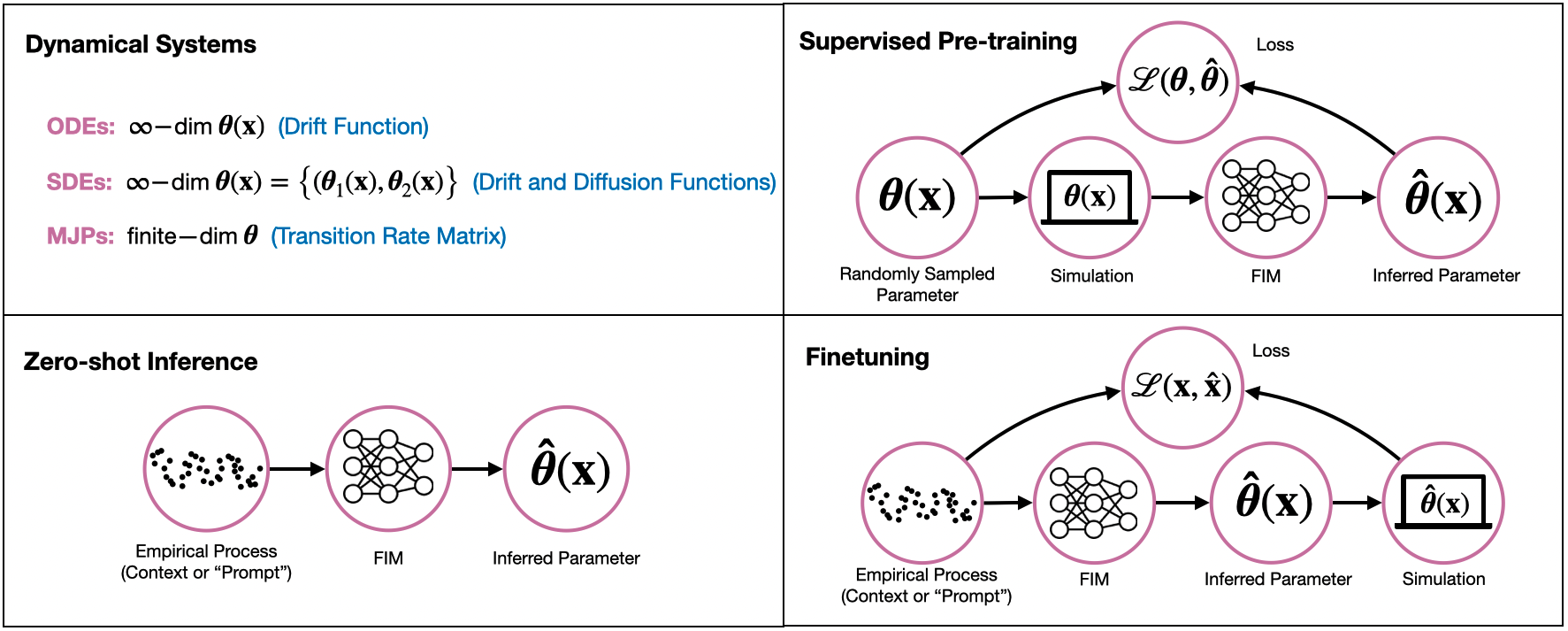
Figure 1:FIM workflows
Construct a broad prior probability distribution over the space of dynamical systems. This distribution represents our beliefs about the general class of systems we expect to encounter in nature.
Sample dynamical systems from this prior distribution, simulate them, and corrupt the simulated paths to generate a dataset of noisy observations and target dynamical systems. This step defines a supervised, meta-learning task that amortizes the inference process.
Train a FIM to match these observation-(target-)system pairs in a supervised way.
Once (pre)trained
FIMs can accurately infer the governing dynamical system in zero-shot (in-context) mode from unseen, noisy, and heterogeneous datasets (Figure 1, lower left); and
FIMs can also rapidly be finetuned to target datasets (Figure 1, lower right).
FIMs therefore amortize the inference of dynamical systems.
The Problem of System Identification or Dynamical System Inference
Inferring dynamical systems from data involves two interconnected challenges:
representation learning — which involves determining appropriate coarse-grained data representations, and
dynamical model fitting — which consists in learning an interpretable set of equations (e.g., ODEs, SDEs) that represent the changes in those representations.
Traditional methods such as symbolic and Gaussian process regression or Neural-ODE/SDE/MJP rely on variational inference to jointly solve both tasks, but its slow convergence and intricate optimization render it impractical for scalable, automated scientific discovery.
The FIM program decouples these learning processes by amortizing the model-fitting step. Indeed, FIMs introduce a form of in-context, simulation-based inference by encoding canonical mathematical models (ODEs, SDEs, MJPs, etc) widely used in science.
- Berghaus, D., Cvejoski, K., Seifner, P., Ojeda, C., & Sánchez, R. J. (2024). Foundation Inference Models for Markov Jump Processes. The Thirty-Eighth Annual Conference on Neural Information Processing Systems. https://openreview.net/forum?id=f4v7cmm5sC
- Berghaus, D., Seifner, P., Cvejoski, K., Ojeda, C., & Sánchez, R. J. (2026). In-Context Learning of Temporal Point Processes with Foundation Inference Models. The Fourteenth International Conference on Learning Representations. https://openreview.net/forum?id=h9HwUAODFP
- Seifner, P., Cvejoski, K., Berghaus, D., Ojeda, C., & Sánchez, R. J. (2025). In-Context Learning of Stochastic Differential Equations with Foundation Inference Models. The Thirty-Ninth Annual Conference on Neural Information Processing Systems. https://openreview.net/forum?id=ceCJPoZOKJ
- Hübers, J. R., Mauel, M., Berghaus, D., Seifner, P., & Sanchez, R. J. (2026). Foundation Inference Models for Ordinary Differential Equations. Forty-Third International Conference on Machine Learning. https://openreview.net/forum?id=ZBHDZDaG0h
- Seifner, P., Cvejoski, K., Körner, A., & Sánchez, R. J. (2025). Zero-shot Imputation with Foundation Inference Models for Dynamical Systems. In The Thirteenth International Conference on Learning Representations. https://openreview.net/forum?id=NPSZ7V1CCY
- Hinz, M., Mauel, M., Seifner, P., Berghaus, D., Cvejoski, K., & Sánchez, R. J. (2025). Towards Fast Coarse-graining and Equation Discovery with Foundation Inference Models. https://arxiv.org/abs/2510.12618